Jetpack Joyride
- 4.4
- Rating
- 100.00M
- Installs
- Free
- Price

 Analysis by App-foxy
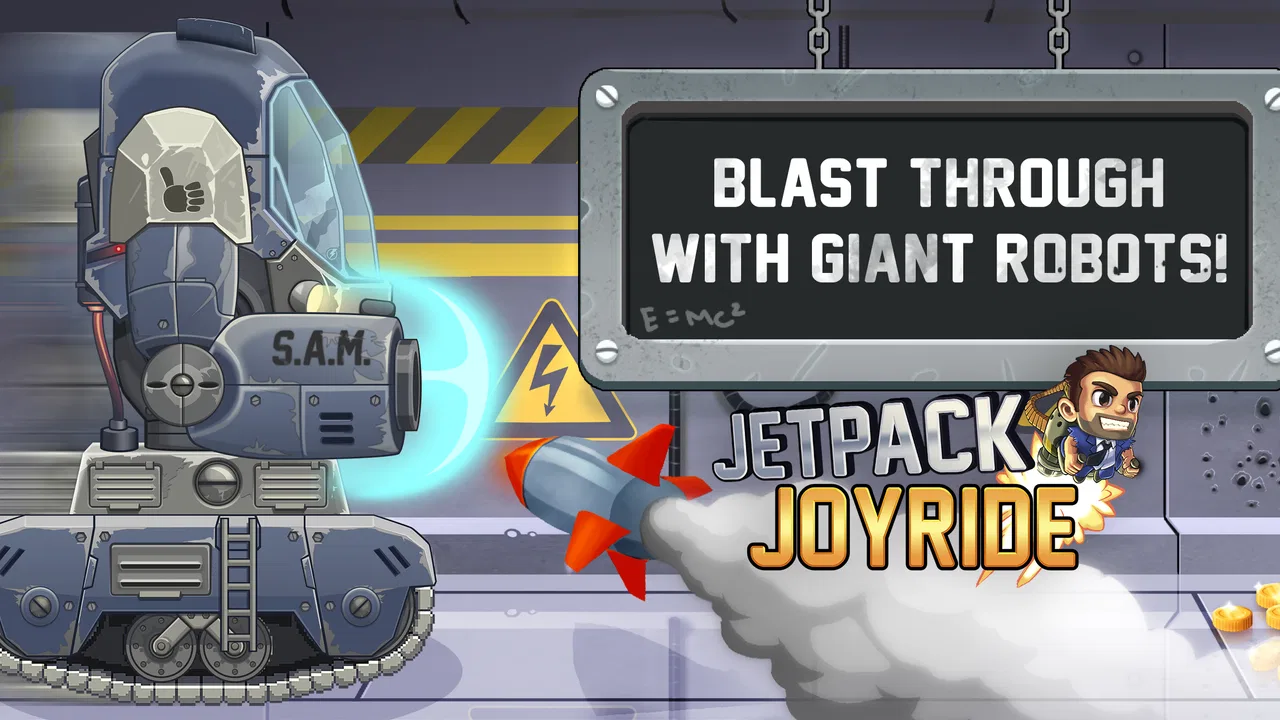
I have always liked arcade games that let me start playing immediately, and Jetpack Joyride fits that mood better than most. It is a fast side-scrolling game from Halfbrick Studios in which the main challenge is to keep moving, react to hazards, and make each attempt feel a little better than the last. I can open it for a short break, understand the controls almost instantly, and still find enough variety to keep a longer session interesting.
The important thing is that it is not trying to be a deep adventure or a slow strategy game. Its appeal comes from quick decisions, repeated runs, unlockable equipment, and the amusing spectacle of a character flying through trouble with a jetpack. That narrow focus works extremely well when I want uncomplicated entertainment, although it also means the game may feel repetitive if I need a constantly changing campaign.
How the arcade loop works in everyday play
The basic rhythm is easy to grasp: begin a run, steer through the laboratory-like hazards, collect useful items, and see how far I can get before the attempt ends. The jetpack gives the movement its personality. Pressing and releasing changes altitude, so even a simple corridor becomes a test of timing rather than a passive ride.
You May Also Like

 Blood Strike: 2.5 Anniversary
Blood Strike’s Loadouts Turn Every Drop Into a Tactical Gamble
A close look at Blood Strike’s custom loadouts: how fast access to signature weapons reshapes its battle royale rhythm, rewards preparation, and narrows the gap between fights.

 Pandora - Music & Podcasts
Pandora’s Music Is Easy to Start, but Harder to Recover
Pandora’s strength is its low-effort path from a seed to a station. Its weak spot is how much confidence it asks you to place in connection, setup, and quiet recovery.

 8 Ball Pool
 Is Built on Rivalries, Rematches, and Routine
A close look at the rivalries, rematches, shared routines, and unanswered safety questions that turn a quick pool match into a persistent mobile community.

 Samsung Music
’s Quiet Strength Is Playing What You Already Own
Its reach comes less from spectacle than from dependable access to a personal library. That simplicity is both the app’s strongest retention engine and its ceiling.

 AccuWeather: Weather Radar
AccuWeather Review: A Quick, Clear Forecast for Everyday Decisions
For everyday plans, the best forecast is the one you can understand quickly. AccuWeather makes rain timing, radar, and local conditions easy to act on, with a few trade-offs.

 Hill Climb Racing
Why Hill Climb Racing Still Turns Crashes Into One More Run
A tiny car, a bumpy hill and one more upgrade: Hill Climb Racing keeps resurfacing because its simple chaos makes every near-miss feel personal.
More From Our News Desk
View All News


What makes the control scheme effective is its small margin for correction. I am not managing a large set of buttons or memorizing complicated combinations. I am watching the screen, deciding whether to rise or drop, and trying to avoid turning a safe route into a collision. That simplicity makes it comfortable on a phone, especially when I am playing with one hand during a commute or while waiting for an appointment.
Runs also become more interesting when vehicles and costumes enter the picture. They are not just visual decorations in the overall presentation; they help give individual attempts a different feel. The game’s exaggerated style makes these changes easy to notice, and collecting them gives me a reason to return after the novelty of the first few runs has worn off.
A useful way to approach the game is to treat each run as practice rather than as a final test. Early attempts teach the timing of obstacles and the behavior of the equipment. I get more from it when I focus on learning patterns and improving decisions instead of becoming frustrated by one unlucky collision.
Small decisions matter more than frantic reactions
The most useful playing habit I found is to avoid holding the jetpack continuously. Constant upward movement can feel safe at first, but it often leaves too little room to adjust when an obstacle appears. Shorter taps give me more control over altitude and make it easier to line up with collectibles or react to a sudden change in the path.
I also try not to chase every item. A collectible is only worthwhile when reaching it does not put the whole run at risk. This is one of the game’s quiet strengths: it creates a simple risk-and-reward decision without needing a complicated ruleset. Sometimes the best move is to stay on a safe line and preserve the attempt rather than make a dramatic detour.
Vehicles deserve a similar approach. They can make a run feel powerful, but I still need to pay attention to positioning. A new vehicle is not a substitute for awareness. When I treat it as a different way to handle the course instead of an automatic advantage, the variety becomes more enjoyable and the results become more consistent.
Why the collection layer keeps the runs from feeling disposable
Arcade games can lose their appeal when every attempt disappears the moment it ends. Here, the collection of vehicles, costumes, and other rewards gives the repeated runs a longer purpose. I may begin by playing only for distance, then shift toward completing a particular objective or trying to unlock something I have not seen yet.
That structure is especially helpful for players who enjoy gradual progress but do not want a large role-playing system. The rewards add direction without changing the game into a complicated inventory simulator. I can still enjoy a five-minute session, yet I also have a reason to return when I want a more focused goal.
The trade-off is that collection systems can change the way I think about the game. Instead of simply enjoying the movement, I may start chasing rewards too aggressively. When that happens, the experience becomes less relaxing. I get the best balance by choosing one goal for a session and accepting that not every run needs to produce something new.
Cost, free access, and what the value really means
The game is free to download and play, which makes the first decision straightforward: I can try the core experience without paying an entry price. That is meaningful value for an arcade title built around short sessions, because I do not need to commit money before knowing whether the controls and repeated-run structure suit me.
There are in-app purchases ranging from $0.99 to $119.99 per item. I would therefore separate “free to access” from “completely free of spending pressure.” The game can be approached without an upfront charge, but players who are sensitive to optional purchases should pay attention to the purchase flow and decide in advance whether they want to spend anything.
For me, the sensible value test is simple: play the free version long enough to learn whether the movement, collection goals, and repeated attempts remain fun. If they do, the game has already delivered entertainment without requiring a purchase. If the loop feels repetitive before that point, spending more would not solve the underlying mismatch.
I would not recommend treating every available purchase as necessary. The central attraction is the act of playing and improving, not owning every possible item immediately. Someone who enjoys collecting may see extra value in optional purchases, while someone who mainly wants a quick arcade distraction can reasonably stay with the free access.
The game is rated Everyone 10+, so it is aimed at a broad audience while still carrying an age classification above the youngest children. Parents should use that rating as a starting point rather than assuming it answers every family question. The more practical issue is whether a child understands optional purchases and can handle a game designed around repeated attempts and rewards.
What I get for the time I put into it
The strongest value is convenience. I do not need to remember a long story, build a complicated strategy, or reserve a large block of time. A run can fit into a small gap in the day, and the controls are readable enough that I can return after a break without relearning everything.
It also offers a good sense of immediate feedback. A mistake is visible, the next attempt starts quickly, and even a failed run can teach me something about timing. That makes it more satisfying than an arcade game where failure simply feels random or where restarting takes too long.
On the other hand, the value is less convincing for players who need a strong sense of completion. The game is designed to continue through repeated runs rather than lead me toward a clearly defined ending. If I prefer a platformer with handcrafted stages, a puzzle game with a finite campaign, or an action game with a detailed story, a different choice may provide more lasting variety.
Where the design starts to show its limits
Repetition is the main limitation. The short-run format is exactly why the game works during spare moments, but it is also why longer sessions can become tiring. Once I have seen the basic rhythm many times, I need to care about a collection target, a better run, or a new vehicle to keep the session feeling purposeful.
The screen can also become busy. Fast movement, obstacles, collectibles, vehicles, and visual effects compete for attention. That energy is part of the charm, but it can make a mistake feel difficult to diagnose. When I fail, I sometimes know that I reacted too late without being sure whether I misread the obstacle or simply became distracted by everything happening at once.
Another trade-off is the difference between skill and progression. Better timing helps a lot, but collecting equipment and rewards can influence how motivated I feel from one attempt to the next. Players who want a pure test of reflexes may prefer a minimalist arcade game with fewer unlocks. Players who enjoy a little collection pressure will probably find the added layer useful.
The game is also less suitable when I want calm, uninterrupted play. Its pace encourages constant attention, so it is not ideal for listening to a podcast closely or playing while multitasking. I can use it during a short wait, but I would not call it background entertainment.
Who should download it, and who should skip it
I think it is a strong fit for people who enjoy endless arcade runs, quick reflex challenges, and light collecting. It works particularly well for someone who wants a game that can be understood in seconds but still rewards better timing over repeated attempts. The free entry also makes it easy for a curious player to test without making a financial commitment.
It is a good choice for a busy day. Imagine having ten minutes before a train arrives: I can complete several runs, focus on one collection objective, and stop without worrying about losing a long campaign session. The same applies to a short break at work, provided the player can give the screen full attention for each attempt.
I would also recommend it to families who want an accessible arcade game for older children and adults, with the reminder that the age rating is Everyone 10+ and that optional purchases exist. Setting a household rule about spending before handing over the device is more useful than assuming free download means there is no purchase consideration.
I would skip it if I dislike repeating the same fundamental action. The jetpack movement is the heart of the experience, and no collection of costumes can change that basic fact. Players looking for exploration, character dialogue, deep customization, or a traditional level-by-level structure will likely be happier with another type of game.
I would also look elsewhere if I want a completely purchase-free environment or if optional items make me feel pressured. The game can be enjoyed without paying, but the presence of purchases between $0.99 and $119.99 per item means it is worth approaching with a clear personal limit.
How it compares with familiar arcade alternatives
Compared with a conventional platformer, this game is less about carefully clearing designed stages and more about surviving an ongoing stream of hazards. That makes it easier to pick up but less satisfying for someone who wants a final level or a carefully paced story. I prefer it when I want instant action, not when I want a structured adventure.
Compared with a simple high-score game, it offers more reasons to return through its vehicles, costumes, and collection goals. The extra systems add personality and progression, although they also make the screen and reward structure busier. A minimalist alternative may be better for players who want nothing between them and the score.
Compared with slower puzzle or strategy games, it demands quicker attention and offers less time to reconsider a move. That is useful when I want energy, but it is a poor match for a relaxed session. Choosing it over those alternatives depends less on quality than on the kind of concentration I want at that moment.
My verdict after weighing the free experience
Jetpack Joyride remains easy to recommend as a free arcade game because it gets the most important things right: immediate controls, short attempts, readable goals, and enough collectible variety to make returning worthwhile. Halfbrick Studios has built an experience that understands the value of a quick restart and a satisfying near-miss.
Its popularity is reflected in an average rating of 4.5 from around 4.8 million ratings, with more than 100 million installs. Those figures do not guarantee that every player will enjoy the repeated-run format, but they do fit my impression that the game has broad pick-up-and-play appeal.
The current version is 1.104.1, and it runs on Android 7.0 or later. That makes it accessible across a wide range of compatible Android devices, though the experience still depends on how comfortable the individual phone is with a fast, visually busy arcade game.
My advice is to download it when you want a lively distraction and judge it by the quality of the free sessions, not by the promise of collecting everything. Set a spending boundary, use short controlled jetpack taps, and choose safe routes instead of chasing every reward. With that approach, the game offers plenty of entertainment without pretending to be something it is not.
In the end, I would buy into the optional content only if I already knew I enjoyed the core loop and genuinely wanted more collection depth. Otherwise, I would keep playing for free. It is best as a polished, repeatable arcade break—not as a replacement for a full adventure game.
FAQs for Jetpack Joyride
01What is Jetpack Joyride and how do you play it?
Jetpack Joyride is an endless runner game developed by Halfbrick Studios. Players control Barry Steakfries, who breaks into a secret laboratory to steal experimental jetpacks. The objective is to fly as far as possible while dodging obstacles, collecting coins, and completing missions. The game features simple one-touch controls, making it accessible for all ages.
02Are there in-app purchases in Jetpack Joyride?
Yes, Jetpack Joyride offers in-app purchases. Players can buy coins and special items to enhance gameplay. These purchases can help unlock new jetpacks, costumes, and vehicles faster. However, it's important to note that these purchases are optional, and players can enjoy the game fully without spending real money.
03What are the main features of Jetpack Joyride?
Jetpack Joyride boasts a variety of exciting features, including a range of jetpacks and vehicles, unique power-ups, and customizable characters. Players can complete missions to earn rewards and compete on leaderboards. The game also offers regular updates with new content and challenges to keep players engaged.
04Is Jetpack Joyride suitable for children?
Jetpack Joyride is generally considered suitable for children, as it features cartoonish graphics and simple gameplay. However, parents should be aware of the in-app purchases and ads. It's a good idea to set up parental controls to prevent accidental purchases and ensure a safe gaming experience for younger players.
05Can I play Jetpack Joyride offline?
Yes, Jetpack Joyride can be played offline. This makes it a convenient game for on-the-go entertainment without the need for a constant internet connection. However, certain features like leaderboards and updates will require an internet connection to access.
Pros
- Addictive gameplay keeps you engaged.
- Smooth controls enhance player experience.
- Diverse missions add variety.
- Unique power-ups boost the fun.
- Regular updates with new content.
Cons
- Can become repetitive over time.
- In-app purchases can be pricey.
- Ads may disrupt gameplay.
- Requires internet for some features.
- Graphics may feel outdated to some.

Jetpack Joyride
Gallery